














































As the research into muscle myopathies increases, the role of nutrition and exercise in combination is becoming increasingly clear in managing the various conditions that come under this bracket.
Exertional Rhabdomyolysis (ER) is an umbrella term that encompasses several different muscle myopathies, some of which involve genetic mutations related to glycogen storage, while other forms don’t have this characteristic.
Current research has grouped the different forms of ER as follows:
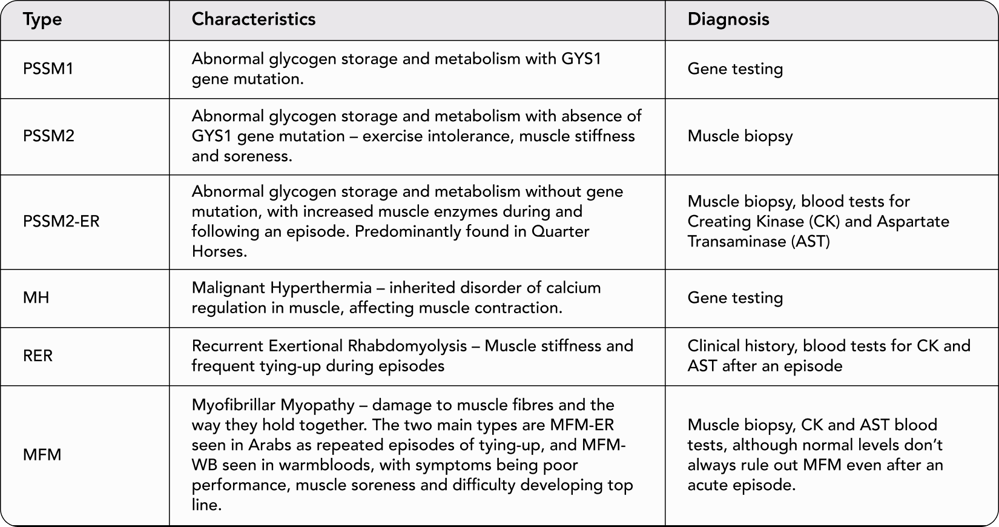
Diagnosis is not always straightforward and usually involves a combination of clinical history and appropriate diagnostic testing. However, identifying the specific type of muscle myopathy can be extremely helpful in determining the most appropriate dietary and exercise strategies for managing the condition.
Feeding Programmes
While controlled trials have been conducted to validate management and dietary strategies for PSSM1 and RER, considerably less data is available on the management of PSSM2-ER and MFM. Recommendations for these conditions therefore rely more heavily on clinical impressions, retrospective studies and owner surveys.
In all cases, the horse’s total nutrient requirements will largely depend on its size, breed, discipline and level of activity. Across all forms of muscle myopathy, forage should form the foundation of the diet. A low forage intake may contribute to episodes of sporadic ER. Approximately 2% of bodyweight on a dry matter basis should be provided over a 24-hour period. As hay is typically 85-90% dry matter, in practical terms this would equate to 22.2-23.5g hay as fed per kg of your horse’s bodyweight. If the horse needs to lose weight, forages with a low digestible energy content may need to be used.
Exertional Rhabdomyolysis with Increased Creatine Kinase
For horses with PSSM1, PSSM2, PSSM2-ER, Sporadic ER and RER, which typically also present with increased Creatine Kinase (CK), current guidelines suggest feeding hay with a low Non-Structural Carbohydrate (NSC) content, ideally less than 12%. Dietary oil should contribute approximately 10–12% of total dietary energy, depending on the horse’s caloric requirements.
For horses that are overweight, or those that maintain their weight easily and can meet their energy requirements through hay alone, a balancer providing 25–30% good quality protein with adequate levels of the essential amino acids lysine and methionine most likely to be undersupplied by forage, can help ensure adequate intake of vitamins, minerals and protein to support normal metabolism and muscle recovery following exercise.
For underweight horses, or those in hard work, a concentrate feed may be necessary. Available data suggests keeping the starch and sugar content of these feeds below 15%. If the feed is already being provided at the recommended level, increasing the amount of oil in the diet can offer additional calories in a relatively safe way.
It is also important to remain mindful of the Omega 3:6 ratio. Linseed oil is ideal, especially for horses with limited turnout, as it contains more Omega 3 then 6 so can help balance the overall diet. Rapeseed oil is another good option, as it does have a higher Omega 3 content than many oils, although the omega 6 content is also high. When additional oil is introduced, dietary Vitamin E should also be increased to help mitigate the additional oxidative stress associated with fat metabolism.
Anxiety and stress can increase the risk of an acute episode in horses with RER. Neurohormonal changes associated with elevated serum glucose, insulin and cortisol concentrations can exacerbate an anxious demeanour. Keeping dietary NSC levels low and providing additional calories through the inclusion of oil, where required, may therefore benefit affected horses through this pathway, in addition to the more established effects on muscle glycogen kinetics.
Beyond these whole-diet strategies, additional Vitamin E has been shown to help maintain a normal antioxidant balance in horses experiencing myopathy-induced muscle damage. Natural-source Vitamin E, in the form of RRR-alpha-tocopherol, is the most biologically available form.
Myofibrillar Myopathy
Although abnormal glycogen accumulation within the muscle does occur in MFM-affected Arabians and warmbloods, it is thought to be a consequence of muscle damage rather than a contributing factor. Consequently, focusing on a low NSC diet may not be as important for these horses as it is for the other forms of exertional rhabdomyolysis discussed above.
For overweight horses, low NSC hay (less than 12%) would still be advisable for metabolic reasons. However, for horses of normal weight or those that are underweight, hay with an NSC content of 12–15% may be appropriate.
Amino acids, the building blocks of protein, are essential for repairing muscle tissue and producing antioxidant enzymes. As oxidative stress is thought to be a likely contributing factor in the degenerative processes associated with MFM, ensuring the horse can produce adequate levels of its own antioxidant enzymes may be beneficial in managing the condition.
Arabians, particularly those competing in endurance disciplines, are generally more reliant on fat metabolism as a fuel source than Thoroughbreds. This increases oxidative stress associated with fat oxidation, which is a major contributing source of reactive oxygen species in exercising muscle. Cysteine, in particular, is an important precursor for the production of endogenous antioxidants, including glutathione. Research into MFM in Arabian horses has identified alterations in cysteine metabolism and reduced levels of certain antioxidant proteins, suggesting that an increased demand for cysteine following exercise may be an important consideration when formulating the diet.
For warmbloods diagnosed with MFM-WB, there appears to be little rationale for feeding a low NSC diet unless the horse is also overweight, has underlying metabolic issues, or has experienced a period of significant muscle damage and soreness that has resulted in glycogen accumulation.
Furthermore, given the additional oxidative stress associated with feeding a high-fat diet, horses that require extra calories to support their workload, or are hard-keepers that struggle to maintain weight, may be better served by increasing their caloric intake through a concentrate feed containing 20–30% NSC and 4–8% fat.
For all types of MFM, the focus should be on providing an overall diet providing 12–14% protein, with particular attention to the amino acids lysine, methionine and threonine. These are the amino acids most likely to be undersupplied in a forage-based diet, and ensuring adequate amounts are available to support muscle repair may be beneficial.
Leucine is also highlighted in the literature as an important amino acid involved in stimulating muscle protein synthesis following exercise. Cysteine is of particular interest for its role in supporting glutathione production and the antioxidant defence system, including the activity of glutathione peroxidase, in horses with MFM.
Supplementation with Cysteine and CoEnzyme Q10 have been explored in a research setting but are not currently permitted for use in horses in the UK or EU. Natural Vitamin E has also been recommended to support antioxidant balance within the muscle.
Summary
For horses with muscle myopathy, understanding the underlying mechanisms responsible for the clinical signs through accurate diagnosis of the specific condition should form the basis of any dietary and exercise strategy. However, as reliable diagnostic testing has not yet been validated for all forms of muscle myopathy, establishing a definitive diagnosis can present its own challenges.
Broadly speaking, horses exhibiting ER, characterised by elevated CK and AST activity following an episode, may benefit from low NSC diets, with supplemental oil and Vitamin E where necessary to maintain an appropriate dietary energy level.
In contrast, horses with MFM are less likely to show the same improvements in exercise-related muscle damage in response to a low NSC diet. Better outcomes may be achieved by focusing on amino acid supplementation to support muscle repair, alongside Natural Vitamin E supplementation to help maintain antioxidant balance.
Whether you enjoy hacking, compete regularly or simply want your horse to feel comfortable and perform at their best, muscle health plays an important role in their overall wellbeing.
Muscle stiffness, difficulty developing topline, poor performance and episodes of tying-up can all be concerning for horse owners. Whilst these signs can have various underlying causes, nutrition can play an important role in supporting horses with diagnosed muscle disorders, alongside appropriate veterinary care and management.
As our understanding of equine muscle disorders develops, it is becoming increasingly clear that there is no one-size-fits-all feeding strategy. Understanding the differences between these conditions can help owners make more informed decisions about their horse's nutritional requirements.
_370.png "Sophie Pelham Burn")