













































_800.png "Are Fructans Sugars? | Equine Science Matters™")
Although fructans are an often-debated topic in equine nutrition, their structure and digestion are frequently misunderstood.
Fructans are a type of non-structural carbohydrate that occurs naturally in grass. In general, cool-season grasses, such as ryegrasses and fescues, tend to contain higher levels of fructans than warm-season grasses. Because of the UK climate, most grazing pasture here is dominated by cool-season grasses. However, grass species are only one factor influencing fructan content.
Environmental conditions also play a major role. Sunlight, temperature fluctuations, rainfall or drought, soil fertility and management, grazing pressure, cutting practices, and the stage of plant growth all influence how much fructan a grass plant produces and stores.
What are fructans?
Fructans play an important role in the plant’s energy storage and resilience, but they can be problematic for horses.
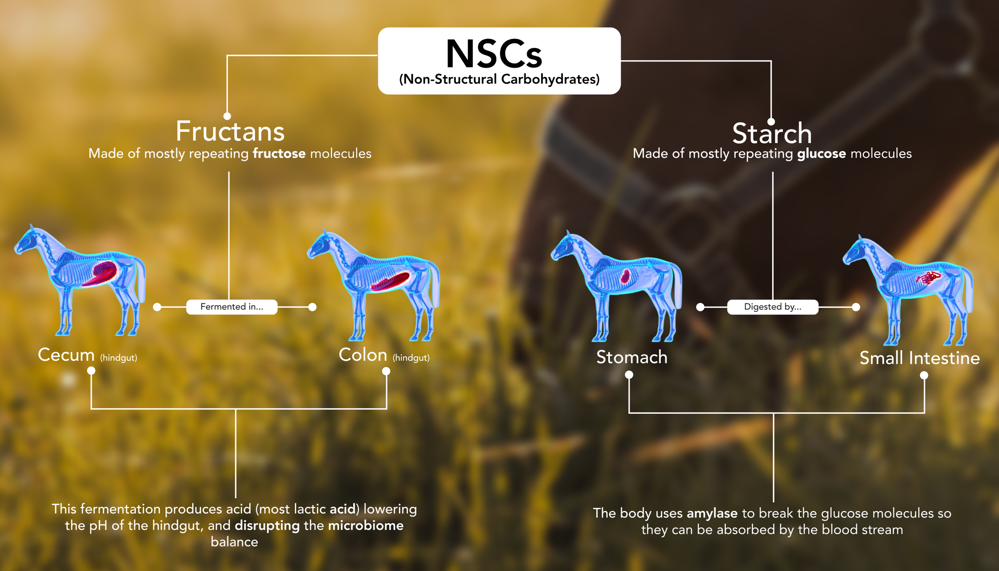
A fructan molecule is essentially a chain of fructose units linked together. In this way, fructans are similar in structure to starch, which is made up of chains of glucose. Both are complex carbohydrates, or polysaccharides, formed from long chains of sugar molecules.
However, this is where the similarity ends.
Starch can be broken down by enzymes produced by the horse and digested in the small intestine, where it is absorbed as glucose. Fructans, on the other hand, cannot be broken down by enzymes in the horse’s small intestine because horses do not produce the enzyme required to break the links between the fructose molecules that make up the long-chain fructans.
This is an important distinction, because although fructans are made of sugars, they do not behave like simple sugars in the diet. A diet high in fructans does not directly raise blood glucose levels or trigger the same insulin response in the pancreas as starch or simple sugars.
Why is that important?
Because fructans are not digested in the small intestine, they pass largely unchanged into the hindgut. There, they are rapidly fermented by the resident microbial population, particularly bacteria that thrive on readily available carbohydrates.
This fermentation process produces acids, including lactic acid, which can lower the pH of the hindgut. As the environment becomes more acidic, it can disrupt the balance of the microbiome.
Research using high-fructan or “fructan overload” models have shown that this can shift the hindgut ecosystem away from a stable, fibre-digesting community towards a more acid-tolerant, fast-fermenting, lactate-producing community.
What does this mean for the hindgut?
While fructans are not inherently toxic to the hindgut, large amounts can lead to significant changes in the microbial ecosystem, including (ref):
-
Inhibition of normal fibre-digesting (cellulolytic) bacteria
-
Death and breakdown (lysis) of parts of the microbial community
-
Altered production and absorption of volatile fatty acids
-
Release of microbial cell components into the gut environment
Together, these changes may impair normal hindgut function and increase permeability to microbial products, including endotoxins. Endotoxins are components of the outer membrane of certain bacteria that can trigger strong inflammatory responses if they enter the bloodstream or surrounding tissues. (REF)
However, it is important to note that the precise molecular mechanisms of gut barrier disruption in horses are not yet fully understood. Much of the current interpretation is based on indirect evidence, such as the detection of endotoxins in the bloodstream alongside observed microbial disruption.
How is this different to starch?
In much the same way that high levels of fructans in the hindgut have been shown to adversely affect microbial diversity, pH, and gut barrier function, excessive starch intake can also have a similar impact. Although the exact mechanisms differ, the overall effect of both starch and fructan overload on the hindgut ecosystem is broadly comparable, as described above.
However, it is important to note that while fructans always pass into the hindgut intact, starch fed in appropriate amounts per meal should be fully digested in the small intestine and absorbed as simple sugars, meaning it should not normally reach the hindgut.
Conclusion
Fructans are a type of complex carbohydrate found naturally in grass. Although they are made up of sugar units, they do not behave like dietary sugars in horses because they are not digested in the small intestine and do not directly raise blood glucose or insulin levels.
Instead, fructans pass into the hindgut where they are fermented by microbes. In large amounts, this can disrupt the normal balance of the hindgut microbiome, lower pH, shift fermentation away from fibre digestion towards rapid carbohydrate fermentation and potentially alter intestinal permeability, often referred to as ‘leaky gut’. These changes may also be associated with reduced stability of the hindgut environment, the release of microbial components such as endotoxins and their absorption into the bloodstream.
While the effects of a high-fructan diet may sound concerning, in practice, it is not possible to eliminate fructans from the equine diet. As fructans occur naturally in all forage, attempting to remove them entirely would risk restricting forage intake, which can lead to a range of other health and welfare issues.
Horses have evolved as forage-consuming animals, and while there is considerable individual variation, their hindgut is, for the most part, well adapted to handle some fructan intake. However, management of grazing and forage should always be undertaken thoughtfully. Any changes to pasture access or hay provision should be introduced gradually, with close attention to signs of discomfort, changes to manure, or changes in behaviour, and adjusted as needed, particularly in relation to seasonal variation or dietary shifts.
_370.png "Sophie Pelham Burn")