














































Poisonous plants for horses
Turnout is great for your horse’s wellbeing and ability to carry out their natural foraging behaviours to help enrich their life, however there are many UK plants that are toxic to your horse. Brushing up on what these plants are and how to recognise them will ensure good pasture management. Most importantly, recognising signs of poisoning will help you quickly to quickly contact the vet in case of accidental ingestion.
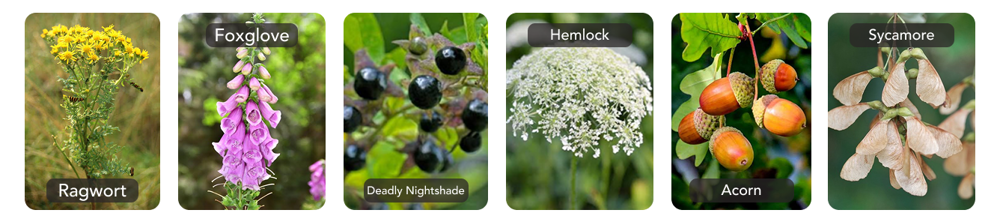
What are the most common poisonous plants/trees to look out for?
- Ragwort
- Foxglove
- Deadly Nightshade
- Hemlock
- Sycamore
- Oak
Ragwort
What does it look like?
Ragwort is extremely common, seen throughout the UK. Recognising ragwort with its distinctive ‘bright yellow’ flower is important as although your horse is unlikely to eat it due to the bitter taste, if grazing is lacking horses may turn to this. Seedlings appear in autumn, with mature plants flowering from May to October.
Why is it a problem?
Ragwort can damage the liver when eaten, causing irreparable damage over time due to the toxic build up. Although overall the plant is bitter, it is to consider that the younger the plant, the less bitter increasing the chance of ingestion. It can also be found in hay or haylage and can be eaten unknowingly.
What are the signs of Ragwort poisoning?
- Depression
- Jaundice
- Photosensitisation
- Neurological issues
How can I remove Ragwort?
- A ragwort fork can be used to get the plant up from the root and before it flowers
- Spraying can be used to treat large areas- but remove all traces before putting your horse back out to graze
- Dispose carefully- the most effective way is to burn the weeds
PLEASE NOTE: It is important to wear protective gloves as it can be harmful to human’s
Foxglove
Alongside Ragwort, Foxgloves grow everywhere in the UK. Luckily, your horse won’t tend to eat fresh foxglove.
This doesn’t reduce the risk though! Just 100g could be fatal to your horse if ingested. Don’t miss the very distinctive ‘bell-shaped’ bright in colour flowers.
What are the signs of Foxglove poisoning:
- Cardiovascular issues – fox gloves increase the strength of heart contraction but slow condition between atrium and ventricle, which can cause cardiac arrest
- Breathing problems
- Digestive upset
- Neurological issues
TAKE NOTE: Foxgloves, can self-seed easily, remove by the root or fence off areas so your horse does not ingest.
Deadly Nightshade
The leaves and berries of this plant, are the most harmful, why? They contain the highest concentration of steroidal alkaloids. What do they do? The toxins interfere with the neurotransmitters in the nervous system, affecting organ systems including the digestive tract, heart and lungs
How can I spot the signs of poisoning?
- Colic
- diarrhoea
- Reduced appetite
- Dilated pupils
- Muscle weakness
- Ataxia
- Paralysis
- Disrupted breathing
Note: Always wear gloves when removing this plant by the root
Hemlock
Does Hemlock look like another plant you see? Out hacking we see lots of Cow parsley and horses love to snack on this and is safe to eat, however it is very important you notice the difference between cow parsley and Hemlock. Hemlock is NOT safe to eat.
How can I spot the difference?
|
Identification |
Hemlock |
Cow Parsley |
|
Stems |
|
Grooved (like celery), short hairs |
|
Smell |
|
|
|
Leaves |
|
|
|
Habitat |
|
|
What happens if my horse ingests Hemlock?
Compounds within Hemlock like pyridine alkaloids which impact the nervous system, causing nervousness, dilated pupils, tremors, potential paralysis and breathing problems.
It is extremely important if your horse is showing any symptoms contract your Vet for urgent veterinary attention!
Trees
Oak trees and acorns
It’s the time of year in autumn where acorns and leaves. The acorns are highly palatable and often addictive.
Consider fencing off areas to oak trees that are near or in your horse’s pasture and check for and remove acorns.
What are the symptoms of poisoning?
- Depression or changes in behaviour
- Stomach problems or pain
- loss of appetite
- Changes in bowel movements
Sycamore trees, seeds and seedlings
Research suggests that as few as 50 sycamore seeds can be fatal to your horse. Young horses, those grazed on short or overgrazed land can be susceptible to poisoning. Sycamore seeds that look like ‘helicopters’ drop from the trees and contain Hypoglycin A which can cause Atypical Myopathy.
What is Atypical Myopathy?
A fatal condition which affects your horses’ muscles and therefore vital organs including the respiratory, digestive and circulatory.
Common symptoms of poisoning include:
- Sweating
- Depression or changes in behaviour
- Muscle stiffness or tremors
- Reluctance to walk
- Breathing difficulties
- Dark urine – red colour
- Collapse
How can I prevent Sycamore poisoning?
- Move horses away from paddocks with sycamore trees or fence off a large area around the tree
- remove sapling plants if you see them
- In fields where grass is limited, feed forage such as hay, to avoid fallen seeds in autumn and early winter when seeds fall.
The Bottom Line
In conclusion, it is so important to be mindful of the poisonous plants in everyday horsey life, always keep an eye out for plants that may harm your horse. There are many more plants including Bracken, Horsetail, Ivy and Yew to name a few. If you suspect your horse has eaten one of these plants, do not wait for symptoms but call your vet immediately.