














































Throughout winter, wet weather, muddy fields and freezing temperatures can mean our horses spend considerably more time in their stables. In some cases, turnout may not be possible at all, and riding can become increasingly difficult, especially when strict yard rules apply.
Horses naturally trickle feed, roam and interact socially throughout the day, so prolonged confinement can affect their mental and physical wellbeing.
Fortunately, there are plenty of simple ways to keep your horse comfortable, entertained and healthy when turnout is restricted. Here are our top tips and tricks for coping with winter confinement.
How to Keep Your Stabled Horse Entertained and Enriched
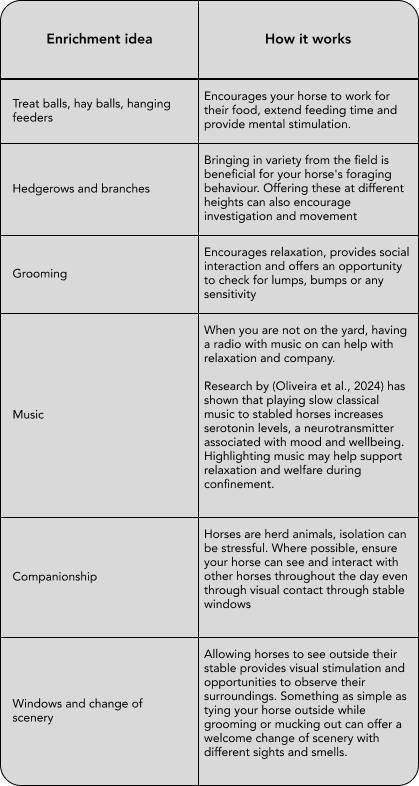
Prolonged stabling can lead to boredom, so it is important to encourage natural behaviours such as foraging, exploring and social interaction.
A study by Brauns et al. (2025) of nine stabled horses found that enrichment activities, including hay feeders, activity balls and mirrors, encouraged natural foraging and movement while reducing signs of frustration. This highlights the importance of providing enrichment to support the welfare of stabled horses.
How to Support Your Horse's Digestive Health During Winter Stabling
Reduced movement, insufficient hydration and changes in forage intake during prolonged stabling can increase the risk of digestive disturbances, including harder droppings. The two main areas to focus on are water intake and forage.
Water Intake
- Always provide fresh, clean water, but monitor drinking during colder weather.
- Adding water to feeds and offering suitable soaked forage can help increase overall moisture intake.
- Adding table salt to your horse's diet can help stimulate thirst, encouraging water intake and supporting hydration.
Did You Know? Warm Water Encourages Drinking
Research by Kristula and McDonnell (1994) involving 14 ponies found that they drank an average of 40% more water when offered warm water compared with near-freezing water. This highlights the benefits of providing warmer drinking water during colder weather to maintain hydration.
Forage
- Provide plenty of hay or haylage to support hindgut health, reduce boredom and encourage saliva production, which helps buffer stomach acid and reduce the risk of gastric ulcers.
- Use small-holed haynets to extend feeding time, encouraging trickle feeding and helping reduce boredom.
- Reduce concentrate feeds where necessary to avoid excess calories, as reduced exercise means lower energy requirements.
- Ensure your horse still receives adequate vitamins, minerals and amino acids, even when feed intake is reduced because your horse is not in work.
How to Help a Horse That Gets Filled Legs in the Stable
When horses remain in the stable for prolonged periods, fluid can accumulate in the lower limbs, resulting in swelling. Reduced movement limits the muscle pump action that supports venous return and lymphatic drainage. This allows the fluid to accumulate in the lower limbs due to gravity and increased hydrostatic pressure.
Tips for Managing Filled Legs
- Use regular hand walking or controlled exercise to help stimulate circulation and increase lymphatic drainage.
- Position water, hay, salt licks and feed in different areas of the stable to encourage horses to move more frequently.
How to Keep Your Horse Mobile: Stretches and Exercises
Prolonged stabling can contribute to reduced muscle mass and stiffness. Simple exercises can help encourage gentle movement, maintain flexibility and activate important muscle groups:
- Carrot stretches
- Weight shifting
These exercises are also a great way to keep your horse's brain activated and engaged while maintaining their flexibility and fitness. Contact your veterinary physiotherapist for exercise advice.
How to Maximise Stable Comfort and Cleanliness
When horses are spending considerably more time indoors, their stable environment becomes even more important, and providing a clean and comfortable stable is essential. A deep, supportive bed can provide cushioning when lying down and getting up, helping protect joints from hard surfaces.
- Keep the bed level to provide consistent support and reduce uneven loading.
- Pick out hooves regularly and maintain dry, clean bedding to reduce prolonged exposure to moisture and bacteria, which can contribute to conditions such as thrush.
How to Recognise Signs of Stress in Stabled Horses
It is important to recognise any changes in your horse's behaviour that may indicate stress, allowing you to adjust their management and support their overall health and wellbeing.
Signs to Look Out For
- Stereotypical behaviours: weaving, box walking or crib biting
- Changes in temperament: increased irritability, aggression or restlessness
- Changes in appetite: reduced forage intake or changes in eating habits
- Changes in behaviour: excessive calling, pawing, door kicking or being withdrawn
Conclusion
Although winter confinement can be challenging, small changes to your horse's daily routine can make a big difference. Providing enrichment, encouraging movement and supporting digestive health can help keep your horse happy, healthy and comfortable throughout the colder months.
References
Oliveira, F.Y.U. de, Odakura, A.M., de Castro Burbarelli, M.F., Ouros, C.C. Dos, de Lima Almeida Paz, I.C., Braz, J.M., Garcia, R.G. and Caldara, F.R. (2024). Impact of musical rhythm on blood, physiological and welfare parameters in stabled horses. Scientific Reports, [online] 14(1), p.31311. doi:10.1038/s41598-024-82637-8.
Brauns, M., Ali, A., Berger, J. and McLean, A. (2025). Physiological and behavioral responses of stabled horses (Equus caballus) to three types of environmental enrichment. Animals, [online] 15(19), p.2779. doi:10.3390/ani15192779.
Kristula, M.A. and McDonnell, S.M. (1994). Drinking water temperature affects consumption of water during cold weather in ponies. Applied Animal Behaviour Science, 41(3–4), pp.155–160. doi:10.1016/0168-1591(94)90020-5.