











































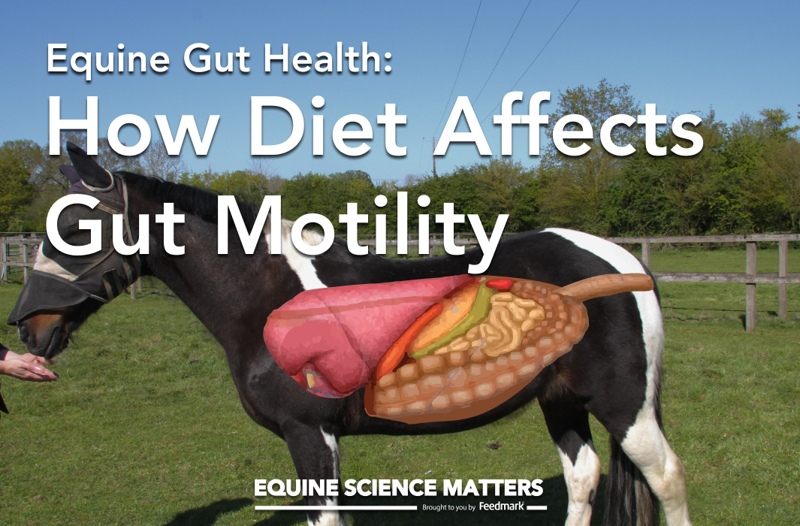
This week, we have broken down a research paper written in May 2026: 'Diet composition influences equine large intestinal motility as measured by transcutaneous ultrasound' Starrett et al., 2026. So that you can stay up to date on recent research behind gut motility and the practical applications for your own horses.
Background & Objectives
The patterns of movement along the horse’s digestive tract, from swallowing right through to the production of manure. Smooth muscle that forms part of the gut wall is responsible for creating these movements; squeezing the food through the small and large intestines at the right pace, and creating a mixing action in the caecum, which is the blind ended sac that houses the majority of the microbiota and is responsible for a large proportion of fibre fermentation and digestion. Horses eating mostly long-stem high-fibre feed such as hay and grass can chew as many as 300-3500 times per kg, whereas a kg of concentrate-based feed may only be chewed 350-400 times. These differences in chewing time and saliva production are likely to affect intestinal function and motility. Previous research has already established that the diet affects motility, although very few studies have investigated diet as the only variable, so there is still a lot to learn in this area.
What they did
The study involved 12 adult American Quarter Horses. The horses ranged from 5 to 26 years old and were all in good health with no teeth abnormalities and a deworming routine. The researchers used a crossover study design, meaning that each horse was tested on both diets so that the effects of the different diets could be compared accurately. The two diets were either hay fed at 2% body weight (BW) and supplemented with a small amount of concentrate feed fed at 0.5 to 0.7% BW, or a complete pelleted feed fed at the manufacturer's recommended rate of 1.35% BW. The horses were gradually introduced to their assigned diet and then allowed 10 days to adjust to it. They were fed twice a day, with their food intake carefully monitored. They were stabled for 2 hours at feed time, then turned out into 1-acre grass-free paddocks for exercise, with the hay-fed horses being given their hay while turned out. After the first feeding period, there was a three-day break before the horses switched to the other diet.
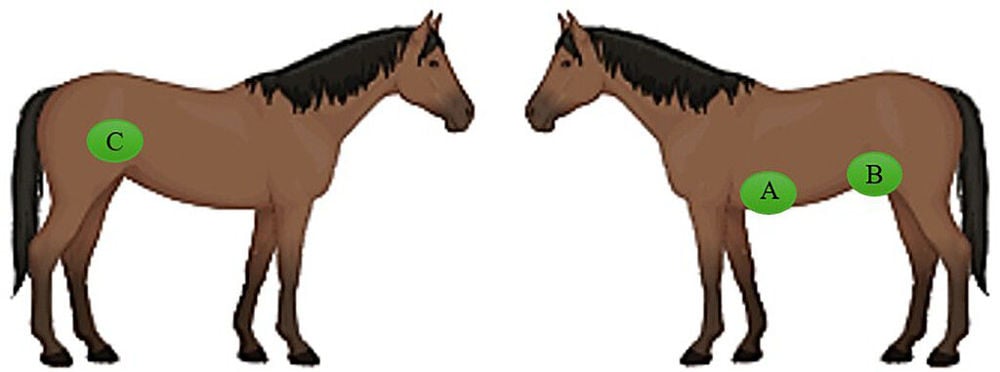
Copied from Starrett et al., 2026
The researchers then measured how frequently the horses' large intestines contracted, as an indicator of gut movement, using ultrasound to observe the intestine through the abdominal wall. Scans were carried out two hours after feeding, in both the morning and afternoon, on three consecutive study days. Two trained ultrasonographers independently counted intestinal contractions at three locations on each horse, recording the number of contractions during four separate one-minute observation periods. A contraction was counted when the intestinal wall moved by more than 2 cm. This approach allowed the researchers to compare intestinal activity between the two diets while keeping the measurement process and other variables as consistent as possible.
What they found
The study found that diet can affect movement in the large intestine of healthy horses. The researchers had expected the horses eating hay with a small amount of concentrate to have more intestinal activity, because hay contains more fibre and takes longer to chew. Chewing also produces saliva, which helps with digestion. However, the opposite was found at one particular part of the large intestine, the sternal flexure: horses eating the complete pelleted diet had more contractions there. The researchers suggest that the way the two diets were eaten may have contributed to this finding. The horses eating hay tended to consume their food more slowly over a longer period, whereas those eating pellets usually finished within an hour. Pelleted feed also requires less chewing and produces less saliva, so differences in how quickly the horses ate, the size of the food particles reaching the hindgut, and how the feed was fermented may all have influenced intestinal movement.
Interestingly, the difference between the diets was only seen at the sternal flexure, where the large colon folds back on itself (at point A on the diagram), and not at the other areas of the large intestine that were examined. This suggests that different parts of the horse's large intestine may respond differently to changes in diet. The researchers also point out that their ultrasound method only counted relatively large intestinal movements, so smaller contractions involved in mixing food and facilitating fermentation would not have been detected.
While the horses on the hay diets with a small amount of concentrate feed were eating for the majority of the time, with some leaving hay uneaten, the horses on the concentrate pellet-only diets were finishing their feeds within an hour. Ingesting large amounts of feed in a short space of time, so that there would be a large amount of feed moving through the digestive system at once with nothing before or after it, would require much larger movements at certain points of the intestinal tract. Additionally, as forage is chewed much more than concentrate pellets, there could be an additional influence of particle size, which has been noted previously in other species.
It’s also worth considering that the researchers mentioned the horses started showing signs of aggression around feed when fed the concentrate diet. We know from behavioural research that horses who aren’t allowed to exhibit their natural foraging behaviours become more stressed, and there are well-described links between the effects of stress on digestive health and vice versa. Previous studies looking at stress and intestinal motility observed decreased movements, but they were done under very different circumstances, so the results aren’t necessarily comparable.
Any of these factors could have affected the results independently of the type of diet itself. Overall, the findings show that what—and potentially how—horses eat can influence large intestinal movement, but more research is needed to understand exactly why these changes occur and whether they have any relevance to the risk of colic. This could have implications for supporting gastro-intestinal health in, for example, veteran horses who can’t chew long-stem forage such as hay and so need to be fed their daily requirements in different forms. Future studies could look more closely at eating speed, chewing, saliva production, food particle size, meal size and frequency and the amount of feed in the digestive tract.
Practical takeaways
Putting this into the context of what we already know about feeding strategies, some practical considerations that this study highlights could be:
- Feed little and often, and where a horse needs to have a high proportion of concentrate feed, this should be divided into several smaller meals for both digestive and mental health.
- Keep meal sizes small to avoid overwhelming the horse’s stomach capacity and pushing feed through to the small intestine before it has spent sufficient time in the stomach to facilitate that initial stage of digestion.
- A horse’s gut doesn’t respond uniformly along the whole length; different areas show different patterns in response to the feed type, which should be taken into account when deciding on a feeding strategy.
- Mixing a concentrated feed into a more fibrous feed such as chaff where possible to encourage extra chewing and saliva production.
Reviewers comments
Despite the differences in gut movement patterns and behaviours around feed noted between the horses when they were having the two different diets, the authors didn’t say that any of the horses experienced colic or digestive discomfort symptoms at all. As such, we can’t interpret the finding as saying that changes to gut motility are necessarily either good or bad. However, this study was only looking at motility patterns. We know from the wider research that feeding two large meals per day with nothing in between is potentially problematic for other reasons, not least gastric ulcer risk. The horses in this study were not assessed for gastric health at all. With a study such as this looking at one aspect of gut health, it’s important to bear in mind that the whole system functions as one, and we can’t ignore the potential impact of feeding practices on the entirety of the digestive tract.
Conclusion
Factors such as exercise, turnout, feeding schedule, housing, stress and the amount of feed actually consumed can all potentially affect gastrointestinal function. The study controlled many of these factors, but what was quite interesting was that the authors, almost by accident, highlighted how broad the range of influences on our horse’s digestion actually are, and how difficult it is to control for all of them. This brings us back to the importance of having suitable management practices and feeding strategies in place to optimise everything we can, so that hopefully the factors we have less control over become less significant.
_370.png "Sophie Pelham Burn")