



_800.png "Salt For Horses: Why Electrolytes Are Important All Year | Equine Science Matters™")
Adding salt is something we often think of in the summer months when our horses are sweating more. Salt is made up of two minerals, sodium and chloride. While requirements of both minerals are heavily influenced by sweat rates, horses do require them in the diet all year round and not just in hot weather or when they are working hard.
Sodium and chloride are vitally important minerals for horses and perform a wide variety of functions. They are necessary for:
-
Fluid Balance: Sodium, along with other electrolyte minerals including chloride, is responsible for correct fluid balance both inside and outside cells.
-
Glucose absorption: When horses eat starch, it is broken down to glucose and absorbed in the small intestine. Glucose passes through the intestinal wall with the help of a transporter protein that requires sodium to function.
-
Digestive health: Sodium is used to create sodium bicarbonate in saliva, which is the key component of the saliva that buffers acid in the stomach. Chloride is used to make hydrochloric acid, which is the primary acid in the stomach. Due to its role in maintaining hydration (see below), sodium is also crucial for digestive function as a whole, as good digestive function relies on adequate hydration status to prevent issues such as impaction colic.
-
Nerve function: Due to its role in transmitting electrical signals down nerves, sodium is crucial in maintaining correct nerve and, therefore, muscle function.
-
Muscle function: Sodium and potassium work together to open calcium channels, which is what allows the fibres in the muscle to contract.
-
Hydration and thirst: When blood sodium levels rise, a thirst response is triggered, prompting horses to drink.
-
Maintaining pH: Sodium and chloride work together to maintain the acid-base balance in all tissues throughout the body.
While forage can provide enough chloride, most horses’ diets are deficient in sodium, even before bearing in mind losses from sweat. Mild deficiency can result in lethargy, dehydration and a loss in appetite and performance, with a drop in hydration status of as little as 2-3% resulting in a decrease in performance of up to 10%. Some horses will eat dirt or lick soil, which is known as pica, although this can also be a result of several other factors rather than solely indicative of sodium deficiency. More severe symptoms of deficiency include muscle cramping or tying up and tremors, decreased gut motility and potentially colic, lack of sweating and therefore heatstroke, and heart arrhythmia.
According to the National Research Council, horses at rest in cool weather require 0.02 × their bodyweight in sodium per day.
-
A 300 kg pony needs about 6 g of sodium daily.
-
A 500 kg horse needs about 10 g of sodium daily.
Since table salt (sodium chloride) is roughly 40% sodium, this equates to:
-
about 15 g of salt for a 300 kg pony
-
about 25 g of salt for a 500 kg horse
These amounts would also provide approximately 9 g and 15 g of chloride, respectively. While this alone would not fully meet total chloride requirements, it would typically cover the gap left after chloride intake from forage.
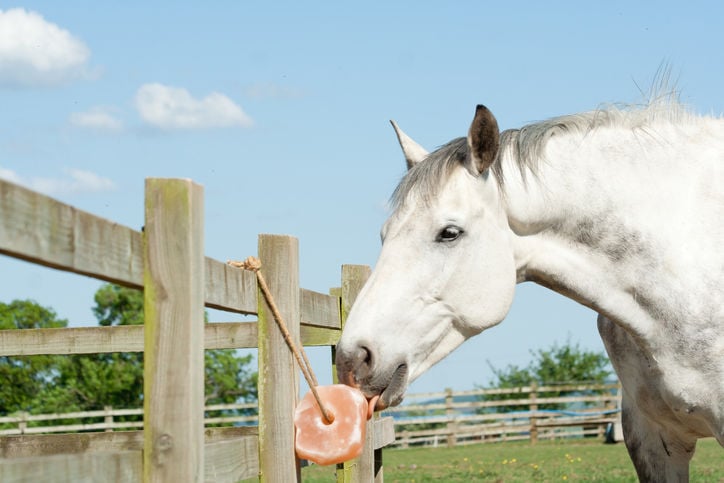
Giving salt in the feeds at a rate slightly higher than requirements is highly unlikely to cause any issues, especially when the horse has adequate access to clean water. While sodium toxicity or hypernatremia can occur, it is generally only found in instances where horses have had nothing other than salt water to drink, or if a sodium-deficient horse is given free access to a salt block. If a salt block becomes used as a toy for a bored horse, and they spend a lot of time licking or gnawing at the block, it may be worth considering providing the salt block for shorter periods and offering alternative enrichment ideas to reduce boredom.
The most common negative effects of giving electrolytes occur through syringe supplementation. Providing high amounts of electrolytes in a concentrated way through syringing should only be done with horses who aren’t already dehydrated. Introducing high amounts of sodium and other minerals into the gastrointestinal system lowers the osmotic potential inside the lumen of the gut, drawing water from outside the gastrointestinal tract into the gut, out of the blood, making the dehydration worse. Offering a drink of water before giving the syringe can help mitigate this effect.
While providing a salt lick is certainly beneficial, as horses have smooth tongues, they aren’t often able to obtain sufficient salt from a lick alone. You may see them gnawing on it or trying to chew the edges if they’re trying to increase their intake. In a herd situation, those further down the pecking order might not be able to get enough time with the salt lick if their herd mates push them away. As such, providing additional salt as part of their feed is advisable.
Sodium and calcium are not the only electrolyte minerals. Potassium, calcium and magnesium are also lost in sweat, but these should already be provided by a balanced diet to a sufficient degree for horses in light work at moderate temperatures. If the horse is working hard enough or in weather hot enough to sweat, it would be worth considering adding an electrolyte supplement which contains all five of these minerals to the diet.
To summarise, all horses and ponies require sodium and chloride in their diets for a multitude of functions. The early signs of deficiency include lethargy and dehydration progressing to loss of performance and appetite. Even in cooler temperatures when horses aren’t sweating, requirements are rarely satisfied by the diet. This is especially true for horses and ponies on restricted diets or soaked hay, as sodium and chloride are both lost during soaking. Supplementation with ordinary table salt is recommended all year round, potentially swapping to an electrolyte supplement in warmer weather or when the horse is sweating regularly to ensure the full spectrum of electrolyte minerals lost in sweat are replaced. The exact rate of supplementation when the horse is sweating to a high degree is highly individual and should be done on a case-by-case basis, and is something our nutritionists would be happy to advise on.
_370.png "Sophie Pelham Burn")