















































How Do the Nutrients in Your Joint Supplement Work?
Joint supplements are one of the most commonly used (non-medicinal) ways to support mobility in horses, dogs and other animals. But what does each ingredient actually do, and how do they work together to support healthy joints?
Below, we explain the role of each key nutrient, how it supports joint health, and the proven effective levels for a 500 kg horse.
Recommended Daily Amounts (500 kg Horse)
|
Ingredient |
Daily Amount |
|---|---|
|
Glucosamine HCl |
18,000 mg |
|
MSM (Methylsulphonylmethane) |
18,000 mg |
|
Chondroitin Sulphate |
6,000 mg |
|
Hyaluronic Acid (Sodium Hyaluronate) |
1,000 mg |
Glucosamine HCl
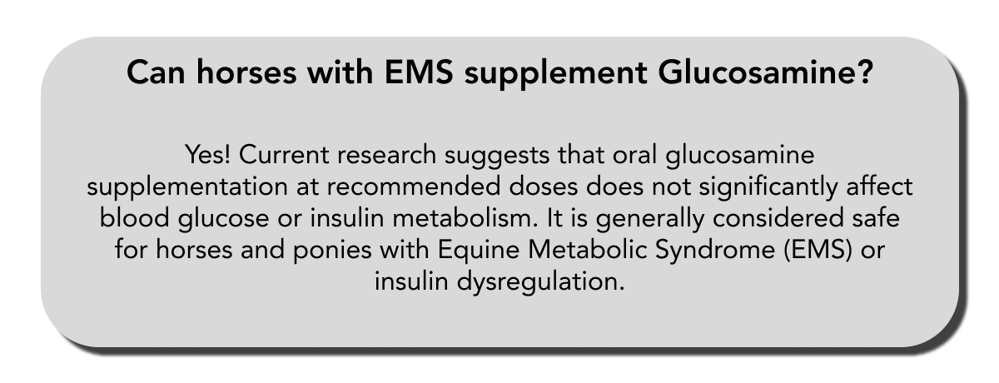
Glucosamine is a naturally occurring amino sugar and one of the primary building blocks used to produce cartilage and synovial fluid. It also forms part of tendons, ligaments and other connective tissues.
Within the body, glucosamine is converted into glycosaminoglycans (GAGs) and proteoglycans. These molecules attract water, creating the gel-like structure that gives cartilage its ability to absorb shock while allowing joints to move smoothly with minimal friction.
Healthy cartilage and well-lubricated joints reduce mechanical stress during movement. Without adequate lubrication, repeated loading can contribute to inflammation and the gradual breakdown of cartilage and synovial fluid. Supporting the production of GAGs and proteoglycans helps maintain cartilage strength, improve shock absorption and promote smooth, comfortable movement.
Chondroitin Sulphate
Chondroitin sulphate is a naturally occurring glycosaminoglycan (GAG) found within cartilage and connective tissue. It helps cartilage retain water, contributing to its strength, elasticity and resilience.
Research suggests chondroitin may also help regulate inflammatory pathways by reducing the production of nitric oxide, an inflammatory mediator that can activate enzymes responsible for cartilage breakdown. By supporting cartilage structure while helping maintain a balanced inflammatory response, chondroitin contributes to long-term joint health.
Hyaluronic Acid (Sodium Hyaluronate)
Hyaluronic acid (HA) is a naturally occurring molecule found throughout the body, produced in synovial fluid, particularly in:
-
Cartilage
-
Skin
-
Eyes
-
Tendons
-
Ligaments
-
Fascia
What is synovial fluid?
Synovial fluid is the thick, lubricating fluid found inside joints. It is produced by specialised cells within the synovial membrane that lines the joint capsule.
Its main roles are to:
-
Lubricate joint surfaces and reduce friction.
-
Cushion joints by absorbing impact during movement.
-
Deliver nutrients to cartilage, which has a very limited blood supply.
-
Remove metabolic waste from the joint environment.
Why is Hyaluronic Acid important?
Hyaluronic acid is the component that gives synovial fluid its thick, gel-like consistency. It has an exceptional ability to bind water, helping joints remain well lubricated and cushioned during movement. Outside of the joint, HA also supports hydration and elasticity within connective tissues such as fascia, allowing tissues to glide smoothly over one another. Reduced levels of HA can lead to increased friction, reduced shock absorption, stiffness and reduced mobility over time.
What affects HA production?
Several factors influence natural HA production:
-
Regular movement stimulates the specialised synoviocytes that produce HA.
-
Hydration allows HA to function effectively due to its strong water-binding capacity.
-
High-impact exercise may increase inflammation, leading to faster turnover of HA and reduced synovial fluid quality.
-
Ageing naturally reduces HA production while increasing oxidative stress within joints, contributing to faster HA breakdown.
MSM (Methylsulphonylmethane)
MSM is an organic sulphur compound that provides a source of biologically available sulphur, an important component of connective tissue.
Sulphur contributes to the formation of collagen and other structural proteins found in cartilage, tendons, ligaments and fascia. These tissues rely on strong collagen networks to maintain flexibility, resilience and strength; MSM also supports the body's normal inflammatory response. While inflammation is an essential part of healing, excessive or prolonged inflammation can activate enzymes that break down cartilage faster than it can be repaired. By supporting connective tissue health and helping maintain a balanced inflammatory response, MSM contributes to healthy joint function.
Vitamin C
Vitamin C (ascorbic acid) is a water-soluble vitamin and an important antioxidant.
Dogs and horses can't produce their own vitamin C. Additional vitamin C may help support antioxidant defences and collagen synthesis during periods of illness, stress or increased physical demand.
Vitamin C supports joint health by:
-
Supporting normal collagen production.
-
Helps protecting cells from oxidative stress.
-
Aids in various cellular functions of the immune systems
Omega-3 Fatty Acids
Omega-3 fatty acids, particularly EPA and DHA, are essential polyunsaturated fats that help support the body's normal inflammatory processes. Omega-3 fatty acids help reduce inflammatory signalling associated with cartilage breakdown while supporting healthy tissue repair. This can help maintain cartilage integrity and support long-term joint health.
Boswellia
Boswellia is a herbal extract obtained from the resin of the Boswellia serrata tree.
Its active compounds, known as boswellic acids, support normal inflammatory pathways. They act partly by influencing the 5-lipoxygenase (5-LOX(enzymes)) pathway involved in inflammatory signalling. By helping maintain a balanced inflammatory response, Boswellia promotes comfort, flexibility and healthy joint function.
To Conclude
|
Ingredient |
Main Role |
|---|---|
|
Glucosamine |
Provides building blocks for cartilage and GAG production |
|
Chondroitin |
Supports cartilage structure and water retention |
|
Hyaluronic Acid |
Maintains healthy synovial fluid and joint lubrication |
|
MSM |
Provides sulphur to support connective tissue |
|
Vitamin C |
Supports collagen production and antioxidant protection |
|
Omega-3 Fatty Acids |
Supports a healthy inflammatory balance |
|
Boswellia |
Supports normal inflammatory pathways |
How Can Joint Supplements Help Your Animals?
Healthy joints rely on a balance between cartilage repair and cartilage breakdown. During exercise or ageing, joints experience mechanical stress, which can stimulate inflammatory signalling molecules such as cytokines. These enzymes gradually break down collagen and proteoglycans, the molecules responsible for cartilage's strength and cushioning.
If this process continues unchecked, cartilage may deteriorate faster than it can be repaired, increasing the risk of stiffness, discomfort and lessened mobility.
A well-formulated joint supplement provides nutrients that support cartilage structure, maintain healthy synovial fluid and help regulate normal inflammatory responses. Together, ingredients such as glucosamine, chondroitin, hyaluronic acid, MSM, omega-3 fatty acids, vitamin C and Boswellia work to support healthy joints, promote smooth movement and help maintain long-term mobility and comfort.