














































Oils are fats which are liquid at room temperature. They provide a very dense source of calories, making them a great way to add extra, slow-release, non-heating energy to the diet for horses or ponies who need to gain weight.
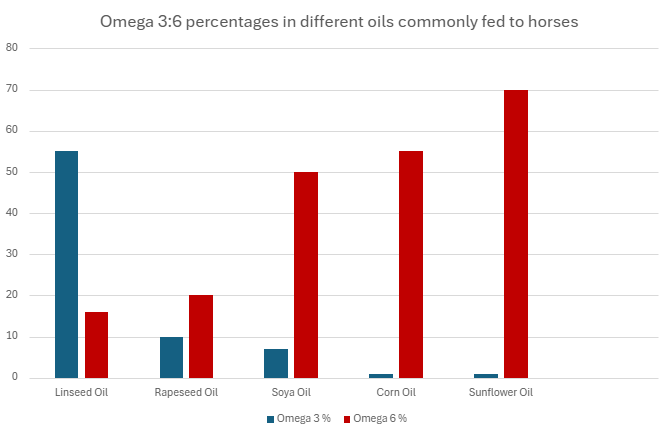
Different oils contain different levels of Essential Fatty Acids. Essential Fatty Acids (EFAs) are types of fats that can't be made in the body, so it's essential that horses get them through their diets. As well as being metabolised to provide energy, the different EFAs perform different roles in the body. The two main categories of EFAs are Omega-3s and Omega-6s. Both are involved in balancing levels of inflammation throughout the horse’s body.
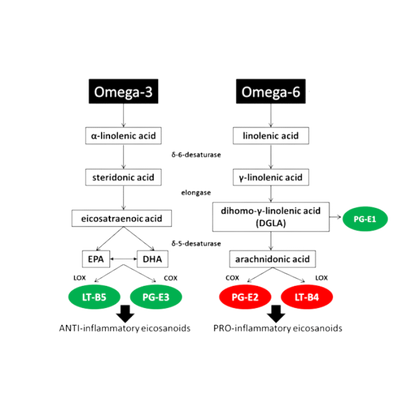
Adapted from Aqeel et al 2017
Omega-3s are predominantly responsible for dampening or calming the inflammatory response and improving cell-to-cell signalling, essentially meaning that every cell within every tissue is better able to communicate with the cells around it. Conversely, Omega-6s are responsible for increasing inflammation. As inflammation is a key part of the immune system and survival, we do need the body to be able to produce an inflammatory response when required. However, issues arise when the inflammatory response is chronic or occurs excessively.
Omega-3s and 6s are both most active in the inflammatory response in their long-chain forms. As it is predominantly the short-chain forms that horses receive through their diets, horses use a specific set of enzymes to convert these to their respective long-chain versions. As both Omega-3s and 6s compete for the same set of enzymes to complete this conversion, providing a high level of short-chain Omega-3s through the diet allows them to out-compete the Omega-6s with a corresponding beneficial effect on inflammatory mediation.
Adding oil to your horse’s diet should be done gradually to let their digestive system adapt to the change. Bile facilitates the digestion of oil and is produced in the liver. In humans, bile can be stored in the gall bladder to be readily available when needed; however, because horses do not have a gall bladder, their bile cannot be stored in large quantities, and thus a sudden change to a high-fat diet will result in the fat not being digested properly. Most horses can tolerate an intake of up to 100ml per 100kgs bodyweight, although it should be introduced and increased very gradually to avoid digestive upset and ensure it can be properly digested and used. Increased oil in the diet also increases the requirement of antioxidants, vitamin E and selenium to ensure it is metabolised properly.
Omega-3s can also help support coat and hoof quality, joint and muscle health, and the respiratory system. When feeding oils to good doers for these purposes, it is important to be mindful of the calorie content to avoid weight gain.
_370.png "Sophie Pelham Burn")